We May Solve Scarcity and Still Live in The Platform
Peter Diamandis predicted a future of technological abundance. The harder question is whether our politics, institutions, and appetite for power will let us live in it.
In his TED talk Abundance Is Our Future, he makes an argument that is easy to dismiss as boosterism and much harder to dismiss once you actually follow the evidence. His claim is that human beings are systematically bad at forecasting the future because our attention is tuned to threat, and because our institutions of information reward alarm over aggregation. Meanwhile, in the background, a set of technologies keeps converting expensive things into cheap things. Computation. Bandwidth. Sequencing. Sensors. Storage. Solar. Each of them followed a cost curve that looked absurd to extrapolate and turned out to be conservative.
The deeper insight in his talk is not really about gadgets. It is a reframing of what scarcity even is.
We tend to treat scarcity as a physical fact, a hard ceiling written into the planet. Diamandis argues that much of what we experience as scarcity is better described as an accessibility problem. There is no shortage of energy striking the Earth. There is no shortage of aluminum in the crust, which was once a metal so difficult to refine that it was displayed alongside crown jewels. There is no shortage of water on a planet that is mostly water. What has been scarce is the technology to make those things usable and affordable at scale.
If that framing is correct, then the question shifts. We are not running out. We are under-engineered.
The case that he is largely right about technology
Since that talk, the argument has aged well on its own terms.
Solar generation went from a boutique alternative to, in many markets, the cheapest new source of electricity ever recorded. Genome sequencing collapsed in price faster than semiconductors did. Satellite imagery, global logistics visibility, real-time translation, and mobile payments moved from state-scale capability to consumer app.
Then artificial intelligence arrived and did something more disorienting. It began applying the same cost curve to cognition.
This is the part Diamandis could gesture at but not fully demonstrate in 2012. Legal analysis, medical triage, code generation, tutoring, research synthesis, design, translation: these were bundled inside expensive specialists and were rationed by credential, geography, and income. A meaningful share of that capability now runs at a marginal cost that rounds to nothing for the person consuming it. A teenager in a country with no software industry can now build and ship a working product. A clinician in an under-resourced hospital can get a differential diagnosis suggestion. A small business can access analysis that used to require a consulting engagement.
As someone who builds software for a living, I find this hard to overstate. The bottleneck of my own field for thirty years was the supply of skilled people. That bottleneck is loosening in real time.
So I am not writing to argue that Diamandis was naive. On the technological axis, the trend line supports him.
I am writing because I have become much less confident about a different axis, and it is the one his thesis quietly assumes.
The assumption underneath the optimism
Technological abundance is a statement about supply. It says the total pool of available energy, calories, intelligence, and productive capacity is growing.
It says nothing about who gets to reach into the pool.
Those are separate problems, and only one of them is an engineering problem. Producing enough is a question of physics, chemistry, and capital. Distributing enough is a question of law, borders, ownership, coercion, and trust. History gives us a great deal of evidence that a civilization can be simultaneously very good at the first and very bad at the second.
Famines are the canonical illustration. Amartya Sen's work on this remains uncomfortable reading precisely because it decouples starvation from harvest. People have starved in regions that were net exporters of food. The failure was in entitlement and access, not in yield.
Scarcity, in other words, is partly manufactured. Not always cynically, and not always deliberately, but reliably. It emerges from ownership structures, from concentration, from restricted access, from monopoly, from sanction regimes, from conflict, and from the ordinary human habit of hedging against an uncertain future by taking more than one needs.
Which brings me to a Spanish film that I cannot stop thinking about whenever I read another optimistic technology forecast.
The Platform
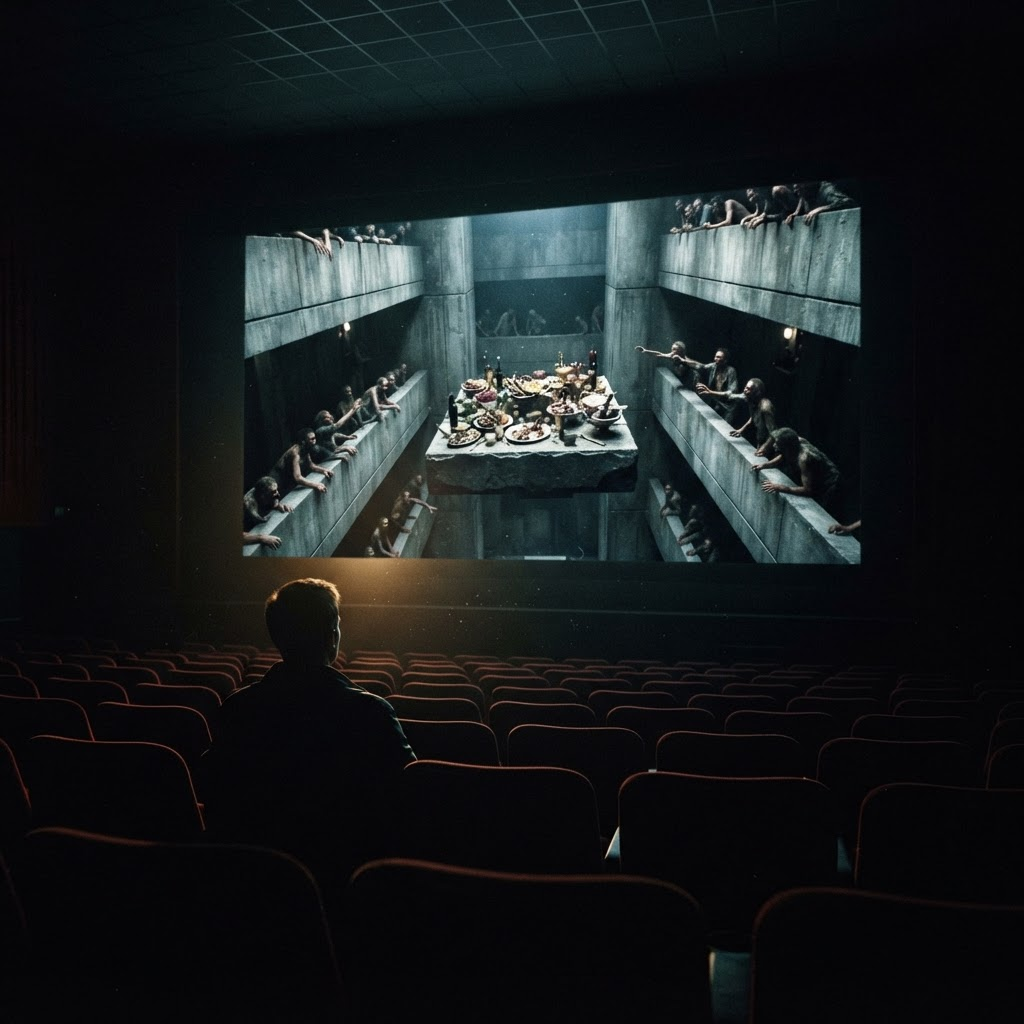
The Platform (El Hoyo) takes place in a vertical prison. Each level holds two people. Once a day, a stone slab loaded with a magnificent banquet descends from the top and stops briefly at each floor on its way down.
The design contains a cruel arithmetic. If everyone on every level ate only their share, there would be enough. The film is explicit about this. The scarcity is not in the kitchen.
What actually happens is that the people on the upper levels eat as much as they physically can, foul what remains, and pass down a wreck. By the time the platform reaches the lower floors, there is nothing, and the people there do things to each other that the film does not soften.
The detail that makes the film a serious piece of political philosophy rather than just a horror premise is this: the residents are reassigned to a random level every month. The person gorging on the fifth floor knows they may wake up on the hundred and fiftieth. Rational self-interest, given perfect information, should produce restraint. It does not. Fear, resentment, the memory of having been starved, and the simple absence of any mechanism to make cooperation credible all overwhelm the arithmetic.
That is the analogy I keep returning to.
Technology is making the platform heavier. It is loading more food, more energy, more intelligence onto the slab than any previous generation could have assembled. Diamandis is right about that.
But the film's problem was never the size of the meal. It was the behavior of the floors.
Rational states, irrational world
The most honest version of this worry is not a story about villains. It is a story about structure.
Consider the present moment. Global military expenditure reached roughly 2.89 trillion dollars in 2025, an eleventh consecutive annual increase and the highest total SIPRI has ever recorded. Advanced semiconductors and the equipment used to manufacture them are now governed by export control regimes rather than by market demand. China responded by tightening licensing on rare earths and critical minerals, including measures with extraterritorial reach. Tariffs, industrial subsidies, supply chain onshoring, and technological sovereignty programs have moved from the margins of trade policy to its center.
Here is the part that resists easy moralizing: almost none of this is unreasonable from the inside.
A state that depends on a single foreign source for the inputs to its power grid, its medicine supply, or its defense industry is genuinely vulnerable. A government that watched pandemic-era supply chains seize up and concluded that resilience is worth paying for is not being paranoid. Export controls on the most capable computing hardware are a defensible response to real dual-use risk. Every one of these decisions can be justified on the merits by a rational actor with legitimate responsibilities to its citizens.
And yet the aggregate is a world spending more on the capacity for violence than at any point in recorded history, fragmenting the supply chains that made abundance cheap, and treating the inputs to the intelligence revolution as strategic munitions.
This is the classic shape of a collective action failure. Each participant behaves defensibly. The sum is worse for everyone. Security dilemmas do not require anyone to want war; they only require that no one can be confident about anyone else's intentions. Under uncertainty, hedging dominates, and hedging looks identical to threatening from the outside.
Diamandis solved for supply. The security dilemma does not care about supply.
Enough is not a quantity
There is a second mechanism, and it operates below the level of states.
Absolute scarcity and relative position are different appetites, and only the first one has a satiation point.
A person with enough food stops being hungry. A person concerned with standing relative to their neighbor never arrives anywhere, because the target moves with them. The same asymmetry scales up. A firm with a dominant market share still pursues consolidation. A country with unmatched military capacity still pursues advantage. This is not straightforwardly irrational, because in a competitive system relative position is itself a form of security.
But it means a large part of human accumulation is not indexed to need at all. It is indexed to comparison, and to fear about the future.
This is precisely the mechanism the upper floors of the Platform are running. Their consumption is not calibrated to hunger. It is calibrated to distrust.
Which produces the question I find most difficult about the abundance thesis:
What if the binding constraint on an abundant future is not our ability to produce enough, but our inability to ever treat "enough" as enough?
Technology can push the production frontier outward indefinitely. It has no purchase on an appetite defined by ratio rather than by amount. You cannot manufacture your way out of a positional good.
Why the future feels dark while the graphs point up
This resolves something that otherwise looks like mass irrationality.
By nearly every material measure, we live in the most capable civilization that has ever existed. Yet the dominant cultural imagination of the future is dystopian. Fiction, and increasingly public sentiment, expects collapse rather than plenty.
The reflexive explanation is that people are ungrateful, or badly informed, or captured by negativity bias. I do not think that is the main thing happening.
I think the intuition is more precise than that. Most people are not predicting that technology will fail. They are predicting that technology will succeed, and that the institutions responsible for distributing what it produces will not.
Notice the actual content of contemporary dystopias. They are rarely about broken machines. They are about functioning machines under concentrated control. Surveillance that works. Automation that works and captures its gains narrowly. Algorithms that work and are pointed at someone's interests rather than yours. The fear is not underproduction. It is asymmetric access to a system operating exactly as designed.
That is a coherent read of the risk, not a failure of gratitude.
Two problems, not one
So I do not think the abundance thesis is wrong. I think it is incomplete in a specific and important way.
It answers the technological question: can we create abundance? The evidence increasingly says yes, and the arrival of cheap cognition may accelerate that answer further than the original argument anticipated.
It leaves open the civilizational question: can we stop ourselves from reconstructing scarcity once abundance becomes technically available?
The second question is genuinely harder, and for an uncomfortable reason. Engineering problems have the property that a solution, once found, stays found. Nobody has to re-derive the transistor each morning. Institutional problems do not behave this way. Cooperation, trust, restraint, and legitimate distribution have to be actively maintained, and they decay under pressure. They are closer to gardening than to construction.
This is not an argument against building. It is an argument that building is the part we already know how to do.
If I am being concrete about what actually matters, I would put it this way. The interesting frontier is not only how fast the cost of intelligence falls. It is whether access to it stays broad as it becomes strategically valuable. It is whether the infrastructure underneath it, the compute, the energy, the minerals, the models, ends up governed as shared capacity or as leverage. It is whether the productivity gains from automation reach the people whose work it displaces on a timescale that matters to their lives rather than to a statistical aggregate.
None of those are engineering questions. All of them will determine whether the abundance we build is something people experience or something they merely read about.
The first floor
I remain, on balance, a technological optimist. I build things because I believe the production frontier is real and worth pushing. I have watched capabilities that used to require institutional scale collapse into a browser tab, and I expect more of that.
But I have stopped believing that the size of the platform is the whole story.
Perhaps humanity's greatest achievement will not be building a platform large enough to feed every floor. Technology may well accomplish that, sooner than most people expect.
The harder achievement will be convincing the people on the first floor that they do not need to eat everything before the platform moves down.
This essay is a reflection on technology and political economy. Figures cited for military expenditure and export controls reflect reporting available at the time of writing and should be checked against the primary sources above.
Frequently asked questions
What is Peter Diamandis argument in Abundance Is Our Future?
He argues that humanity systematically underestimates the future because attention is tuned to threat, and that exponential technologies keep converting expensive scarce goods into cheap abundant ones. His core reframing is that much of what we call scarcity is an accessibility and technology problem rather than a physical ceiling.
Is the abundance thesis wrong?
Not on its technological axis. Cost collapses in solar, genome sequencing, computation and now AI-delivered cognition support it. The essay argues the thesis is incomplete rather than incorrect, because it addresses supply while leaving distribution and power unresolved.
How does the film The Platform work as a metaphor for scarcity?
In the film a banquet descends through a vertical prison, and there would be enough for every level if each ate only its share. The upper floors overconsume out of distrust and fear of future reassignment, so the lower floors receive nothing. The failure is behavioral and institutional, not a shortage of food.
Why can rational national decisions produce an irrational global outcome?
Export controls, stockpiling, onshoring and defense spending are each defensible responses to genuine vulnerability, but under mutual uncertainty every actor hedges, hedging is indistinguishable from threatening, and the aggregate is fragmentation and record military expenditure. This is the structure of a security dilemma and a collective action failure.
Why does the future feel dystopian if material capability keeps improving?
Contemporary dystopias generally depict technology working rather than failing: functioning surveillance, functioning automation whose gains are narrowly captured, functioning systems pointed at someone else interests. The fear is asymmetric access to a well-designed system, which is a coherent institutional worry rather than simple pessimism.
What is the difference between absolute scarcity and positional competition?
Absolute need has a satiation point, so a person with enough food stops being hungry. Relative standing has no satiation point because the target moves with you, so firms, states and individuals keep accumulating past need. Technology can expand production indefinitely but cannot resolve an appetite defined by ratio rather than amount.